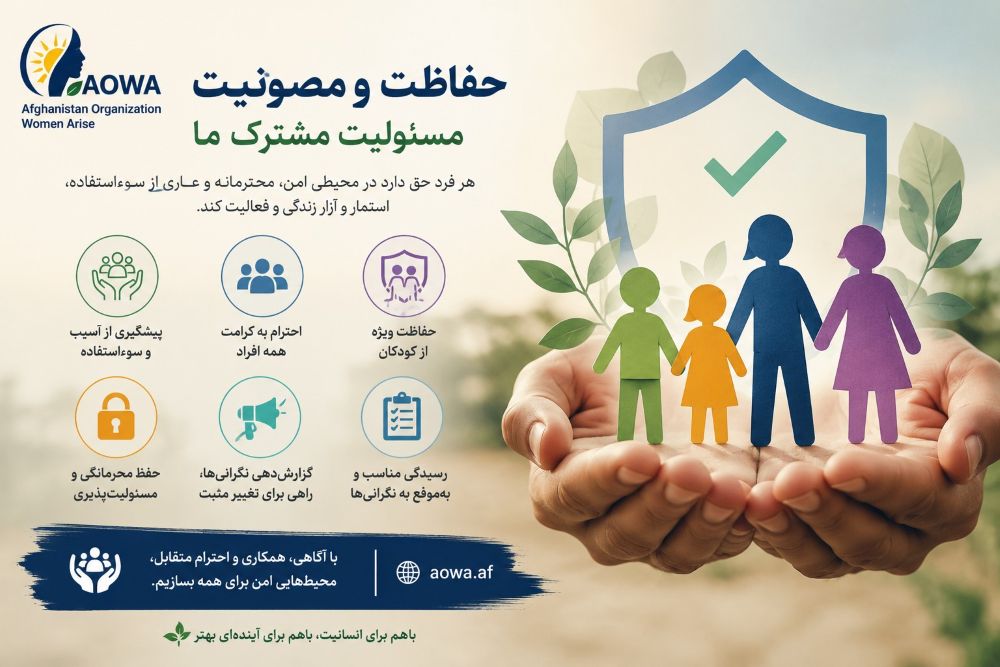
Every person, particularly children, women, young people, and those who may face greater vulnerabilities, has the right to live and participate in an environment that is safe, respectful, and free from abuse, exploitation, harassment, and other forms of harm.
Afghanistan Organization Women Arise (AOWA) considers safeguarding a fundamental and shared responsibility. The organization seeks to apply principles throughout its activities and interactions that contribute to creating safe, respectful, accountable, and supportive environments.
What Does Safeguarding Mean?
Safeguarding refers to the policies, principles, actions, and responsibilities designed to prevent harm, abuse, exploitation, harassment, and other inappropriate behavior toward people. It also includes taking appropriate and responsible action when a safeguarding concern or incident is identified.
Safeguarding is not simply a document or policy; it should be part of an organization’s culture and everyday practice.
From AOWA’s perspective, creating a safe environment requires all staff, volunteers, partners, and others involved in the organization’s activities to understand their safeguarding responsibilities and act accordingly.
What Principles Does AOWA Emphasize?
AOWA gives particular attention to the following principles:
🛡️ Preventing harm and abuse
Identifying and reducing risks that may expose people to harm.
🤝 Respecting people’s dignity
Every person should be treated with respect, dignity, and without discrimination.
👧 Giving special attention to child protection
Children require particular care and protection because of their age and specific circumstances.
🔒 Confidentiality and accountability
Safeguarding concerns and reports should be handled with sensitivity, confidentiality, and responsibility.
📢 Encouraging reporting of concerns
People should know how and through which appropriate channels they can report concerns when they witness or experience inappropriate or harmful behavior.
⚖️ Appropriate response to concerns
Every safeguarding concern should be taken seriously and followed up appropriately in accordance with relevant policies and procedures.
Who Is Responsible for Safeguarding?
Safeguarding is not the responsibility of one person or one department within an organization. Managers, staff, volunteers, partners, and others who are connected with AOWA’s activities all have a role in creating safe environments.
Organizational leadership is responsible for promoting an appropriate safeguarding culture and establishing the systems needed to support it. Staff members are expected to maintain professional conduct, recognize potential risks, and take appropriate action through established mechanisms when concerns arise.
Families and communities can also play an important role by increasing awareness, cooperating with relevant actors, and reporting concerns responsibly to help create safer environments for children and others.
Why Is Safeguarding Important?
Even a single incident of abuse or inappropriate behavior can have serious consequences for the affected person, their family, and the wider community. Therefore, preventing harm and creating safe environments before harm occurs must receive serious attention.
A responsible organization can maintain community trust when, alongside delivering services, it also places strong emphasis on the safety, dignity, and rights of the people with whom it works.
AOWA seeks to strengthen safeguarding as an important part of its organizational culture and to promote an approach based on prevention, awareness, accountability, and responsibility.
Safeguarding as Part of Organizational Culture
Safeguarding is most effective when it does not remain only in policies and documents, but is reflected in staff behavior, engagement with communities, program design, and the way services are delivered.
Creating safe environments is an ongoing process that requires training, awareness, risk identification, cooperation, and commitment from everyone involved.
AOWA believes that safeguarding people is not merely an administrative duty; it is a shared ethical and humanitarian responsibility.
By working together, we can create environments where children, women, young people, and others can live and participate with a sense of safety, respect, and dignity.