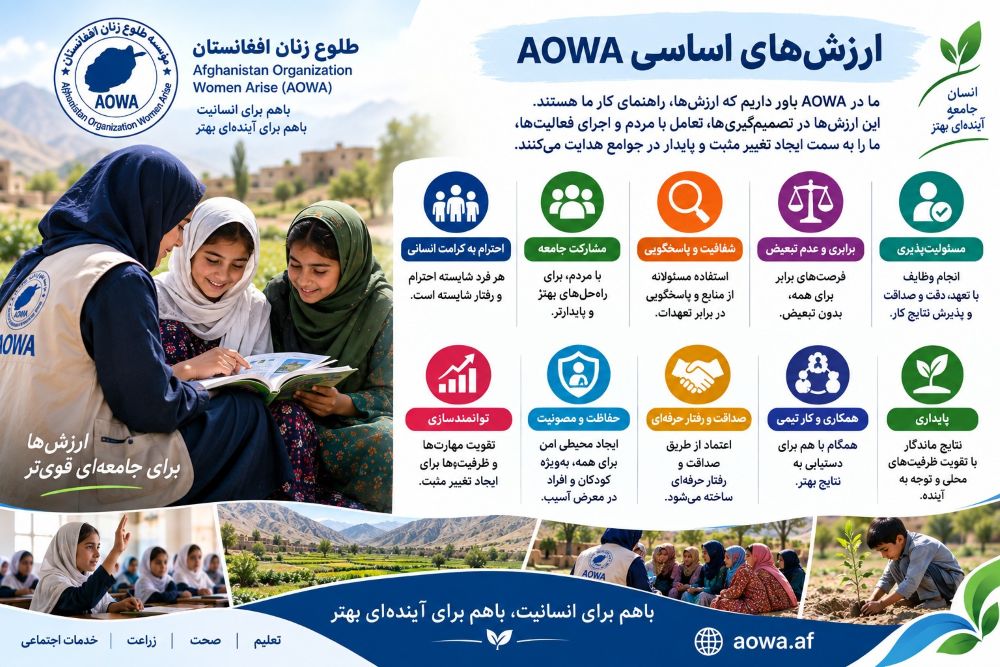
Every organization needs principles and values that guide its work and support the achievement of its goals. These values provide a framework for decision-making, engagement with communities, program implementation, and interaction with staff, partners, and other stakeholders.
Afghanistan Organization Women Arise (AOWA) is committed to values that place human dignity, accountability, community participation, empowerment, and positive and sustainable change at the center of its work.
Respect for Human Dignity
Respect for human dignity is a fundamental value in AOWA’s engagement with individuals and communities. Every person, regardless of their social or economic circumstances, gender, age, or position, deserves to be treated with dignity and respect.
AOWA seeks to ensure that individuals and communities are treated respectfully and that no person is subjected to humiliation, discrimination, or inappropriate treatment because of their circumstances or position.
Community Participation
AOWA believes that communities are an important part of the solution to the challenges they face. Listening to people’s views, needs, and suggestions and creating opportunities for their participation can contribute to better program design and implementation.
Meaningful community participation includes listening to people’s voices and recognizing local knowledge, experience, and capacities. AOWA seeks to build relationships with communities based on cooperation, respect, and mutual trust.
Transparency and Accountability
Trust is an important foundation for the work of any social organization. Transparency in decision-making, responsible use of resources, and accountability for commitments are among the factors that help establish and maintain this trust.
AOWA seeks to fulfill its responsibilities responsibly and remain accountable to communities, staff, partners, and other stakeholders.
Equality and Non-Discrimination
AOWA believes in fair treatment and appropriate opportunities for individuals to participate, develop, and contribute to their communities.
Recognizing differences within communities does not mean creating discrimination. Rather, it means considering the different circumstances and needs of individuals and groups when designing and implementing activities so that programs can respond more effectively to community needs.
Responsibility and Accountability
Responsibility means carrying out duties with commitment, care, and integrity and accepting responsibility for the results of activities.
AOWA seeks to ensure that its staff and responsible personnel perform their duties professionally and responsibly, taking into account organizational objectives, community needs, and established working principles.
Responsibility also means learning from experience, identifying areas for improvement, and making appropriate adjustments in future activities.
Empowerment
Development is not limited to providing services. Strengthening the ability of individuals and communities to create positive change is equally important.
AOWA seeks to contribute to empowerment through awareness-raising, skills development, creating appropriate opportunities, and supporting existing capacities.
Empowerment becomes more meaningful when individuals and communities are better able, over the long term, to use their knowledge and skills for informed decision-making, greater participation, and improved living conditions.
Safeguarding and Protection
Protecting people from harm, abuse, exploitation, and inappropriate conduct is an important responsibility in social and humanitarian work.
AOWA emphasizes the importance of safeguarding and protection principles in its activities and interactions and seeks to promote an environment where individuals, particularly children and other people at risk, are treated with respect and receive appropriate protection.
Safeguarding is not the responsibility of one specific department alone. All staff and individuals involved in the organization’s activities have a role in contributing to a safe and respectful environment.
Integrity and Professional Conduct
Integrity is an important element of trust and sustainable cooperation. Providing accurate information, acting honestly, and avoiding the misuse of organizational positions are important aspects of professional conduct.
AOWA seeks to build its working relationships on integrity, respect, cooperation, and professional principles while keeping the interests and dignity of individuals and communities at the center of its work.
Cooperation and Teamwork
Sustainable change is rarely the result of the efforts of one individual or organization alone. Cooperation among staff, communities, local institutions, partners, and other relevant stakeholders can strengthen capacities and create opportunities to make better use of available knowledge, experience, and resources.
AOWA values teamwork, coordination, and constructive cooperation and seeks to use diverse capacities to achieve better results.
Sustainability
Development activities have greater value when their positive results can continue over time.
AOWA seeks to consider not only immediate needs but also local capacities and the potential for sustaining results when designing and implementing programs. Strengthening knowledge, skills, and community capacities can contribute to more sustainable outcomes.
Commitment to Continuous Improvement
Work in social, educational, health, and development sectors requires continuous learning and adaptation. The circumstances and needs of communities may change, and organizations need to learn from their experiences to improve their approaches.
AOWA values learning from experience, receiving feedback, and identifying areas for improvement in order to strengthen the quality and effectiveness of its activities within its available capacities and resources.
Putting Our Values into Practice
Values become meaningful when they are reflected in everyday behavior, decision-making, program implementation, and interactions with people and colleagues.
AOWA seeks to put values such as respect for human dignity, community participation, transparency and accountability, equality and non-discrimination, responsibility, empowerment, safeguarding and protection, integrity, cooperation, and sustainability into practice throughout its activities.
These values can contribute to stronger trust, more effective cooperation, and activities that are more closely aligned with the needs and circumstances of communities.
AOWA believes that trust is built through integrity and accountability, positive change grows through community participation, and sustainable development becomes more achievable through the empowerment of individuals and communities.