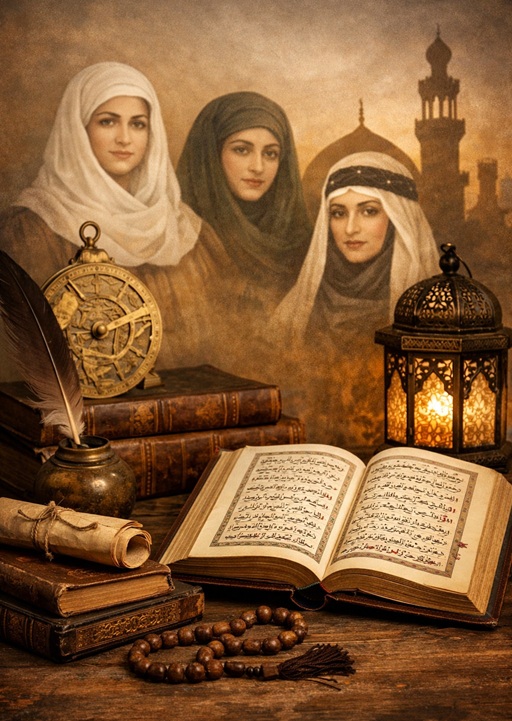
As the new academic year begins, reflecting on the value of knowledge and education through the lens of Islamic teachings is more important than ever. The history of Islamic civilization clearly demonstrates that women have consistently played active and influential roles in various fields of knowledge, particularly in religious sciences.
Throughout different periods of Islamic history, especially during the classical era, distinguished women emerged in the fields of Hadith, Tafsir, Fiqh, and education. Among them was Aisha bint Abi Bakr, who is regarded as one of the greatest narrators of Hadith. Many companions and successors sought knowledge from her. Likewise, Umm al-Darda al-Sughra was a prominent scholar who taught in the Umayyad Mosque of Damascus, where students—including leading scholars and rulers—attended her lessons.
In the 6th century Hijri, often regarded as a flourishing period of scholarship, notable female scholars such as Fatima bint Abbas al-Baghdadiyya and Karima al-Marwaziyya held esteemed positions in the field of Hadith and education. Many prominent scholars traveled to learn from them and received authorization (ijazah) for transmission.
This rich legacy illustrates that access to education has not only been a social necessity but also an integral part of our religious and intellectual tradition. Authentic Islamic sources emphasize the pursuit of knowledge as an obligation upon every Muslim—both men and women—without restriction to any particular group.
It is evident that a society which nurtures all its human potential is better positioned to achieve progress and development. Education serves as the foundation for intellectual, moral, and social growth, and plays a vital role in shaping future generations. In this regard, the contribution of women, as half of society, remains indispensable.
The Tolou-e-Zanan Organization, guided by Islamic values and the rich scholarly heritage of the past, believes that promoting education and creating enabling environments for learning for all members of society can significantly strengthen the intellectual and cultural foundations of communities.
It is hoped that, inspired by the luminous history of Islamic civilization, opportunities for learning and growth will continue to expand in ways that allow all individuals to contribute meaningfully to the future of their country through knowledge and understanding.